
Most people climb Sigiriya without knowing the story. They puff up the 1,200 steps, snap a photo from the top, and head back down none the wiser. Which is a shame, because the story of this rock is one of the great tales of the ancient world. Betrayal, murder, paranoia, and a king who built himself a palace in the sky. Once you know it, the climb stops being a workout and becomes something closer to time travel.
A throne soaked in blood
Rewind to the 5th century AD. The king of the day, Dhatusena, had two sons. One, Moggallana, was born to the queen and was the rightful heir. The other, Kashyapa, was born to a lesser consort. Knowing the throne would never be his by birth, Kashyapa did what desperate men in ancient stories tend to do. He seized it by force, overthrew his father, and according to the chronicles, had the old king walled up alive and left to die.
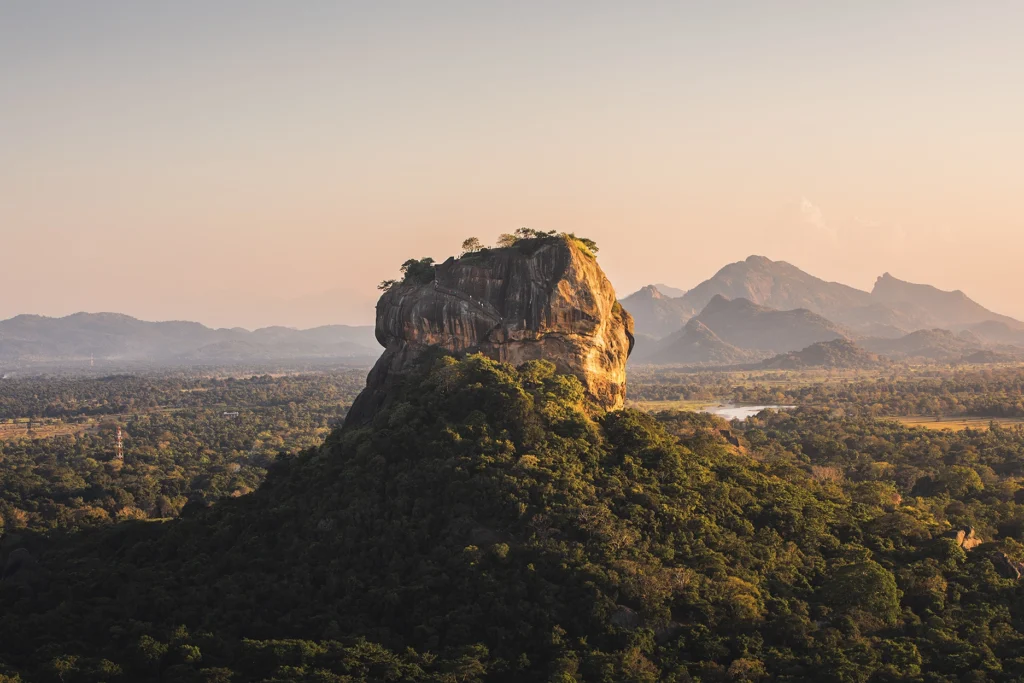
With his brother Moggallana fleeing to India vowing revenge, Kashyapa had a problem. He was a usurper and a murderer, and the rightful heir was out there somewhere, raising an army. So he did something extraordinary. He abandoned the traditional royal capital and moved his entire court to the top of a 200-metre rock rising straight out of the jungle, building a fortress-palace where no army could easily reach him. Part stronghold, part statement, part act of paranoia. Sigiriya was born.
For 18 years Kashyapa ruled from his sky palace, surrounded by water gardens, frescoes and the kind of luxury that suggests a man trying very hard not to think about what he’d done. Then, in 495 AD, his brother finally came back with an army. The two forces met on the plains below. The story goes that Kashyapa’s war elephant turned to avoid a swamp, his own troops thought he was retreating, and the line broke. Cornered and defeated, Kashyapa took his own life. The palace was handed to Buddhist monks, who kept it as a monastery for centuries before it was swallowed by the jungle and largely forgotten.
It sat hidden until British explorers stumbled on it again in the 1800s. Today it’s a UNESCO World Heritage Site and the most famous landmark in Sri Lanka.
Why people come
So why does a ruined rock fortress pull travellers from all over the world? A few reasons, and they stack up fast.
The first is the sheer audacity of the engineering. Fifteen hundred years ago, with no modern tools, someone built a palace, landscaped water gardens and a frescoed gallery on and around a sheer 200-metre rock. The water gardens at the base still work, filling during the rainy season exactly as they were designed to, which makes them some of the oldest surviving landscaped gardens in the world. Most visitors march straight through them on the way to the steps. Slow down. You’re walking through 1,500-year-old hydraulic engineering.
Then there are the frescoes. Halfway up, sheltered in a rock pocket, are the famous Sigiriya damsels: painted women, vivid in red and gold, who have gazed out over the jungle for fifteen centuries. There were once said to be hundreds of them wrapping the rock face. Around twenty survive, and photography is banned to protect them, which somehow makes standing in front of them feel even more like a privilege.
Just past the frescoes is the Mirror Wall, once polished so smooth the king could see his reflection as he walked. Over the centuries, visitors scratched verses and notes into it, some more than a thousand years old. It’s ancient graffiti, and historians have used it to understand how the old Sinhala language sounded and evolved.
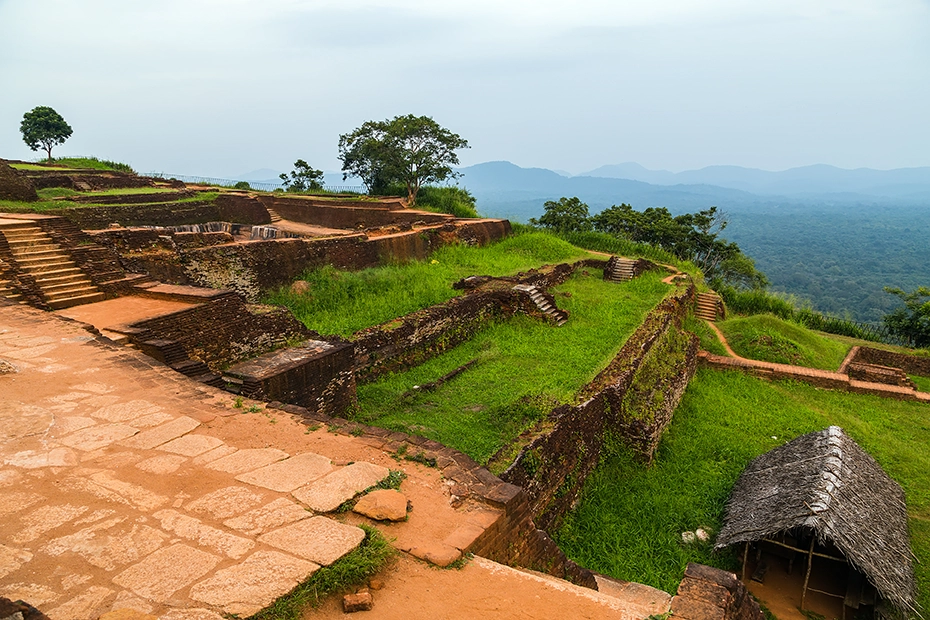
And then, of course, there’s the climb to the top, through the enormous lion’s paws that give the rock its name (Sigiriya comes from Sinhagiri, “Lion Rock”), up the final steep staircase, to the summit where the palace once stood. The ruins up there are modest now, just foundations and a throne cut from stone, but the view is staggering: jungle stretching to the horizon in every direction. You understand, standing there, exactly why a frightened king felt safe.
The modern reality, and how to do it right
Here’s the honest part most glossy guides skip. Sigiriya today is hot, busy, and not cheap for foreign visitors. The entrance fee sits at around 30 to 35 US dollars, which is steep by Sri Lankan standards and far more than locals pay. The rock has almost no shade, the midday heat is brutal, and tour groups cluster thick around the lion’s paw terrace by mid-morning.
None of that means skip it. It means time it well. Aim to be at the gate when it opens early in the morning, ideally on a weekday, before the heat builds and the bus groups arrive. Wear proper shoes (the steps are uneven and worn smooth in places), bring more water than you think you need, and pack a hat and sunscreen. The whole climb takes most people around 90 minutes return at a comfortable pace.
If the fee or the crowds put you off, there’s a famous alternative right next door. Pidurangala Rock, a ten-minute drive away, is a steeper, more scrambly climb that costs a fraction of the price and rewards you with the one view Sigiriya itself can’t give you: Lion Rock standing proud above the jungle, especially magical at sunrise. The locals have a saying worth remembering. Climb Sigiriya for the history, climb Pidurangala for the view. If you have the time and the legs, do both. Pidurangala for sunrise, then Sigiriya once you’re back down.
The amazing things waiting around it
Here’s what really makes Sigiriya worth the trip: it sits in the heart of Sri Lanka’s Cultural Triangle, surrounded by some of the best things to do on the whole island. Base yourself here for two or three days and you can fill every one of them.
Dambulla Cave Temple. Just 20 to 25 minutes away, this is the largest and best-preserved cave temple complex in the country. Five caves cut into a granite overhang, filled with more than 150 Buddha statues and ceilings painted with murals spanning 2,000 years. It’s a UNESCO site in its own right, and an easy half-day paired with Sigiriya.
Minneriya and Kaudulla safaris. Around 30 minutes from Sigiriya, Minneriya National Park hosts one of the great wildlife spectacles in Asia: “The Gathering,” when up to 300 wild elephants congregate around the receding reservoir, usually between July and October. It’s far quieter than the famous southern parks like Yala. In the wetter months the herds shift to nearby Kaudulla, so a good operator will take you wherever the elephants actually are. A quick, important note: skip any elephant rides you’re offered in town. They’re not ethical. Watching wild elephants from a jeep is the right way to see them.
Polonnaruwa. About an hour east lies the medieval capital of Sri Lanka, a sprawling, beautifully preserved set of ruins, palaces, temples and giant rock-carved Buddhas. It’s flat and compact enough to explore by bicycle, which is one of the most enjoyable ways to spend a morning in the Triangle.
Ritigala. For something quieter and more mysterious, the ruined forest monastery of Ritigala sits deep in the jungle on a mountainside about 40 minutes away. Stone pathways, meditation platforms and ancient steps being slowly reclaimed by the trees. Hardly anyone goes. If you want the feeling of discovering something, this is it.
A hot air balloon at dawn. For a splurge, drift up over the whole region in a hot air balloon at sunrise, with Sigiriya, the jungle, the lakes and the distant hills laid out beneath you in the golden early light. It’s one of the most memorable things you can do anywhere on the island.
Village life and cycling. Closer to the ground, you can join a village tour around the Hiriwadunna area, take a catamaran across a tank, eat a home-cooked rice and curry, or rent a bicycle and roll out through the paddy fields and back roads at your own pace. This is the gentle, human side of the Triangle, and often the part people remember most.
The bottom line
Sigiriya isn’t the cheapest or the easiest thing you’ll do in Sri Lanka. It’s hot, it’s popular, and the climb will make you sweat. But it’s also a 1,500-year-old sky palace built by a guilt-ridden king, ringed by ancient gardens and frescoes, sitting in the middle of the richest concentration of history and wildlife on the island. Set the early alarm, learn the story before you go, and give it the two or three days the area deserves. You won’t just tick off a famous rock. You’ll feel the whole weight of the island’s history in one extraordinary place.
Planning your visit
Sigiriya sits in the Cultural Triangle in central Sri Lanka, easiest reached from Kandy (around 2.5 hours) or Dambulla (20 minutes). For more on getting around the island and timing your trip, take a look at our plan your trip guides, and our cultural festivals calendar if you want to line your visit up with a festival.